The Story of Kushary

From an Indian soldier's ration to Cairo's most beloved street food — and finally, a UNESCO World Heritage dish.

Kushary is one of food history's great accidents — a dish born from empire, immigration, and Egyptian ingenuity. No single person invented it. No single country owns it. It evolved over two centuries on the streets of Cairo, shaped by every culture that passed through.

How Kushary Came to Be

1800s
India

The Indian Root: Khichri

The story begins in India, with khichri — a humble porridge of rice and lentils cooked together with spices. When the British East India Company expanded its operations, khichri travelled with soldiers and colonists as a cheap, nutritious staple. The name "Kushary" almost certainly derives directly from "khichri", carried westward through the British colonial network.

1820s–
1880s

British Occupation Brings It to Egypt

As Britain extended its influence over Egypt — formally occupying it from 1882 — khichri arrived in Alexandria and Cairo with the colonial administration. Egyptian cooks and vendors quickly adopted the rice-and-lentil base, recognising how well it suited the local climate and working-class palate: filling, inexpensive, and easy to make in bulk.

Late
1800s

Italian Immigrants Add Pasta & Tomato

During the late nineteenth century, Egypt's cosmopolitan boom drew large communities of Greeks, Italians, Lebanese, and Syrians to Alexandria and Cairo. Italian immigrants brought macaroni and the concept of tomato-based sauces. Egyptian street vendors, ever practical, began adding pasta to the rice-and-lentil bowl — and suddenly a new layer of flavour and texture appeared that would define Kushary forever.

Early
1900s

Cairo Makes It Its Own

Egyptian cooks transformed the borrowed ingredients with their own culinary heritage: cumin, coriander, and chilli from ancient spice routes; caramelised onions central to Egyptian cooking; and the sharp, garlic-vinegar sauce (dakka) that gives Kushary its signature kick. The dish became distinctly, unmistakably Egyptian — no longer a derivative of anything foreign.

1950s–
1970s

The Golden Age of Kushary Shops

Dedicated Kushary restaurants proliferated across Cairo, particularly in working-class districts. Shops like Abu Tariq and Koshary El Tahrir became neighbourhood institutions — walls of stainless steel pots, bowls assembled in seconds, queues stretching onto the pavement. Kushary was fast food long before the term existed, and it fed a city.

2011

Kushary and the Arab Spring

When Tahrir Square became the focal point of Egypt's 2011 revolution, Kushary was there. Street vendors fed protesters for days from large pots set up around the square. For many Egyptians, this cemented Kushary as more than food — it was a symbol of solidarity, resilience, and the everyday life of ordinary people.

Dec
2025

UNESCO World Intangible Cultural Heritage

At its 20th session in New Delhi, UNESCO's Intergovernmental Committee inscribed Kushary on the Representative List of the Intangible Cultural Heritage of Humanity — the first Egyptian dish ever to receive this recognition. The inscription acknowledged not just the food, but the entire living culture around it: the vendors, the rituals of assembly, the shared tables.

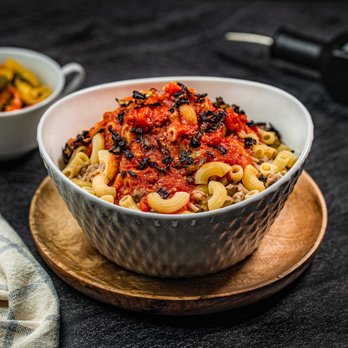
A traditional bowl of Kushary

More Than a Meal

In Cairo, Kushary is eaten by everyone. The university student, the office worker, the construction labourer, the taxi driver — all queue at the same counter, eat from the same type of bowl. It is one of the few foods in Egypt that genuinely crosses class boundaries.

The Kushary shop itself is a social institution: noisy, fast, democratic. You shout your order, your bowl arrives in under a minute, you customise your sauces, and you eat standing up or perched at a shared table. There is no pretension, no waiting.

This is what UNESCO recognised — not just a recipe, but a way of being together.

"

Koshary is enjoyed by people of all ages, genders and backgrounds across rural, urban and coastal communities. It is shared with neighbours and friends, served at family gatherings, and offered at national events.

— UNESCO Intangible Cultural Heritage Committee, New Delhi 2025

A Dish Without Borders

Kushary is the product of centuries of trade, migration, and culinary exchange. Every component has a story.

🌾

Rice & Lentils

India via Britain

The base comes from khichri, the subcontinental rice-and-lentil dish that arrived in Egypt with the British colonial administration in the nineteenth century.

🍝

Macaroni

Italy via Alexandria

Pasta was introduced by the large Italian community that settled in Alexandria and Cairo during Egypt's cosmopolitan boom of the late 1800s and early 1900s.

🍅

Tomato Sauce

Mediterranean influence

The spiced tomato sauce (salsa) reflects both Italian influence and the rich Egyptian tradition of slow-cooked, garlic-forward sauces found across Levantine cooking.

🧅

Caramelised Onions

Ancient Egypt

Onions have been cultivated in Egypt for over 5,000 years and are central to its cooking. The caramelised onion topping is the most distinctly Egyptian element of the dish.

🧄

Garlic-Vinegar Sauce

Egyptian invention

The sharp dakka — a blend of garlic, vinegar, cumin, and lemon — is a purely Egyptian creation. Nothing like it exists in the source cultures; it is the dish's fingerprint.

🌶

Spices & Chilli

Ancient spice routes

Cumin, coriander, and chilli pepper reached Egypt through centuries of Indian Ocean and Silk Road trade. Egyptian cooks wove them into every layer of the dish.

Official Recognition  ·  December 2025

Now Officially World Heritage

In December 2025, UNESCO inscribed Kushary on its Representative List of the Intangible Cultural Heritage of Humanity. It is the first Egyptian dish ever to receive this distinction — formal recognition of a food culture that has been thriving on Cairo's streets for more than a century.

Read the official UNESCO inscription →
What's next

Ready to Make It Yourself?

Head to our recipes page for a step-by-step Kushary guide — or come taste the real thing at a pop-up.

See the recipe → Join the mailing list